
Why isn't it working? hot water on a yacht?
Discover the most common faults in heaters and hot water systems on board, how to identify their symptoms and when it is necessary to carry out a specialized technical inspection.
Hot water systems on board
Specialized technical diagnosis
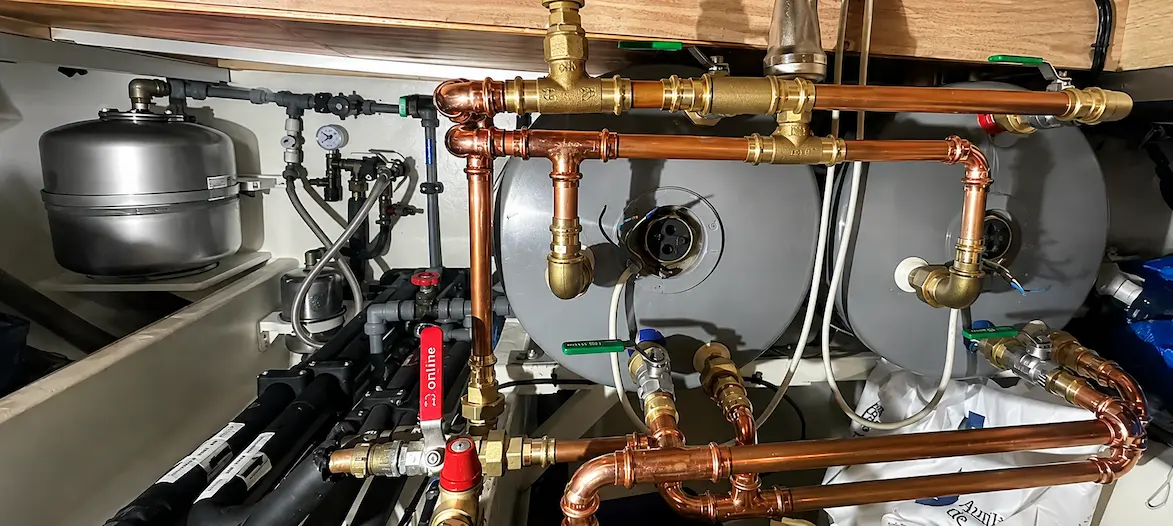
Signs that your yacht's water heater may be failing
A lack of hot water doesn't always mean the water heater is completely broken. In many cases, the problem may lie with the heating element, the thermostat, the valves, the circuit pressure, or limescale buildup inside the system.
Detecting the first symptoms allows action to be taken before the breakdown affects onboard comfort, causes a leak, or ends up damaging other components of the freshwater system.
If the problem appears suddenly, recurs frequently, or is accompanied by water leaks, it is advisable to check the entire system and not replace components without a prior diagnosis.
Most common symptoms
The water does not reach the correct temperature
It comes out lukewarm or completely cold even though the system has been running for the usual time.
The hot water runs out too quickly
The available volume is less than normal or the temperature drops after a few minutes of use.
Leaks or drips appear around the equipment
It could be a safety valve, a connection, a gasket, or internal corrosion of the tank.
The temperature changes irregularly
The water alternates between cold and hot or presents abrupt variations during use.
The heater is making unusual noises.
Knocks, vibrations, or internal sounds may indicate air, sediment, limescale, or pressure problems.
Why might the hot water stop working?
A yacht's hot water system combines electrical, hydraulic, and mechanical components. Therefore, the same malfunction can have different causes and is not always resolved by simply replacing the heater.
Faulty electrical resistor
The heating element is responsible for heating the water when the yacht is connected to the electrical grid. If it loses efficiency or burns out, the water may remain cold even though the system appears to be on.
Defective thermostat
A thermostat that misreads the temperature can prevent the heating element from turning on, turn it off too soon, or cause irregular changes in the hot water.
Accumulation of lime and sediments
Mineral deposits reduce the efficiency of heat exchange, increase consumption, and can generate noise, slow heating, or a lower hot water capacity.
Leaks in valves or connections
A leak in the safety valve, gaskets, or connections can reduce pressure, cause air to enter, and ultimately damage other elements of the circuit.
Expansion vessel failure
The expansion vessel absorbs the pressure changes that occur when the water is heated. If it loses pressure or deteriorates, leaks, water hammer, and continuous discharges from the valve may occur.
Internal corrosion of the heater
Over time, the tank can suffer internal corrosion, especially if the protective anode is depleted. This can lead to rusty water, small leaks, or even the tank's eventual rupture.
It is not advisable to replace parts without checking the entire system.
A new heating element won't solve the problem if the source is pressure issues, limescale buildup, a faulty valve, or a leak in the system. A thorough diagnostic prevents unnecessary repairs and allows faults to be detected before they affect the rest of the system.
Why is the yacht's heater leaking water?
A leak in the hot water system doesn't always originate from the tank. The source could be a valve, a gasket, a hydraulic connection, excessive pressure, or internal damage to the water heater itself.
The exact location of the leak determines the type of repair.
When water appears around the yacht's water heater, it is important to first check if the leak occurs during heating, when a tap is opened, or even with the system completely stopped.
Occasional dripping from the safety valve may be related to the expansion of the water as it heats up. However, if the dripping is continuous, increases frequently, or wets the utility compartment, there may be a pressure problem, a faulty valve, or an empty expansion vessel.
If water appears directly on the casing or base of the equipment, there is a possibility of internal corrosion or perforation of the tank. In that case, a superficial repair is usually not sufficient.
In the technical spaces of a yacht, a continuous loss can affect the insulation, wiring, pumps, linings and structures located around the hot water system.
Most common causes of a leak
Defective safety valve
It may remain partially open, lose its seal, or discharge continuously due to excess pressure in the circuit.
Damaged joints or connections
Vibrations, temperature, and the passage of time can loosen connections or deteriorate gaskets and fittings.
Expansion vessel without pressure
If it does not properly absorb the expansion of the water, the pressure increases and the system discharges through the valve.
Internal corrosion of the tank
A worn-out anode or insufficient maintenance can promote corrosion and cause a permanent leak.
When does an immediate review be required?
The severity depends on the amount of water, the location of the leak, and the equipment located around the heater.
It's worth keeping an eye on it and checking if it only appears during the heating cycle.
It is necessary to check pressure, valves, connections and expansion vessel before the problem worsens.
It is recommended to stop the system and perform an inspection to avoid damage to electrical installations or nearby equipment.
Why does the hot water run out too quickly?
If the water reaches the correct temperature but cools down after a few minutes, the problem may be related to the tank capacity, temperature regulation, limescale buildup, or simultaneous consumption at different points on the yacht.
It doesn't always mean the heater is broken.
The amount of water available depends on the tank volume, the programmed temperature, the recovery speed, and the number of showers, sinks, or equipment consuming water at the same time.
In some cases, the system works correctly, but It is not sized for the actual consumption of the yacht.In others, performance has declined due to lack of maintenance.
Insufficient tank capacity
The stored volume may be too small for the number of people on board or for the simultaneous use of several showers.
Temperature set too low
If the water is stored at an insufficient temperature, a higher proportion of hot water is needed during each use.
Accumulation of limescale inside
Mineral deposits reduce usable capacity and hinder heat transfer, increasing recovery time.
Thermostatic mixer incorrectly adjusted
Incorrect regulation can introduce too much cold water or cause temperature variations during consumption.
Simultaneous consumption at multiple points
Using showers, cooking, and sinks together can quickly deplete the available hot water supply.
Thermal recovery too slow
A deteriorated heating element, poor circulation, or poor heat exchange can delay the heating of the new volume.
It is advisable to check three aspects
Measuring usage minutes helps to compare performance with tank capacity and temperature.
Simultaneous consumption can explain a rapid drop without a direct breakdown.
An excessively long time to reheat the water may indicate a loss of efficiency or a deteriorated component.
How do you check the hot water system of a yacht?
A technical inspection should not be limited to checking if the water heater turns on. It is necessary to analyze the entire system's behavior, from the electrical supply and pressure to the valves, connections, and points of consumption.
This approach allows differentiation between an actual equipment failure, a loss of performance, or a problem located elsewhere in the circuit.
Functionality check
It is checked whether the water reaches the correct temperature, how long it takes to heat up, and for how long it maintains a stable supply.
Electrical and thermal inspection
The power supply, resistance, thermostat and protection systems are checked to detect cuts, overheating or a loss of efficiency.
Pressure control and valves
The working pressure, the safety valve, the expansion vessel, and the system's behavior during heating are checked.
Leak and connection inspection
Joints, fittings, pipes and the base of the tank are examined to locate visible leaks or initial signs of corrosion.
Capacity and recovery time
The tank capacity is compared with the yacht's actual consumption and the time required to have hot water available again.
Lime, sediments and corrosion
The presence of mineral deposits or corrosion can reduce usable volume, increase consumption, and shorten the life of the equipment.
Temperature in showers and taps
Mixers, valves and points of consumption are also checked to confirm that the water reaches all areas at a stable temperature.
A complete diagnosis prevents unnecessary component replacement.
Reviewing the entire system allows you to locate the real source of the fault and decide whether it is advisable to repair, perform maintenance or replace any component.
How to avoid breakdowns in the hot water system
Preventive maintenance allows for the detection of wear, loss of performance, initial leaks, and pressure problems before the system stops working.
On a yacht, this inspection is especially important before a busy season, a voyage, or a charter period, when a breakdown can directly affect the comfort of guests and crew.
Scheduled maintenance reduces unexpected breakdowns.
The hot water system operates under constant temperature, pressure, vibration, and use. Over time, these factors affect valves, seals, connections, electrical components, and the tank itself.
Regular inspection allows action to be taken before problems arise. leaks, corrosion, temperature loss, or service interruptions.
Check valves and connections
The condition of joints, fittings, pipes and valves is checked to detect small leaks, wear or signs of corrosion.
Control system pressure
Incorrect pressure can cause continuous discharges, pipe knocking, and premature wear of components.
Check resistance and thermostat
Electrical and thermal inspection allows for the detection of power loss, deteriorated connections, or inadequate operating temperatures.
Assess limescale, sediment, and corrosion
Mineral deposits and internal deterioration reduce performance, increase warm-up time, and can shorten the life of the equipment.
The best time to check the system is before it fails.
Scheduling an inspection before the season allows time to repair, clean, or replace components without affecting the yacht's normal operations.
Palma, STP, Club de Mar, Puerto Portals, Port Adriano and the main ports of the island.
Solutions for hot water systems on yachts
A malfunction in the hot water system can affect the comfort of guests and crew, but can also cause leaks, pressure problems and damage to the technical compartment if it is not checked in time.
We reviewed the entire system to pinpoint the true source of the problem.
We checked the water heater, heating element, thermostat, valves, pressure, expansion vessel, pipes, connections, and distribution to showers and faucets. The goal is to restore proper functioning and prevent the same problem from recurring.
Do you need to have your yacht's hot water system checked?
Diagnosis, repair and maintenance of hot water systems.
Palma, STP, Club de Mar, Puerto Portals, Port Adriano and other ports.
Technical plumbing for yachts, recreational boats and superyachts.